
How precision manufacturing enables AI, robotics, and industrial innovation – and why Estonia deserves greater visibility in European manufacturing.
Artificial intelligence, robotics, and automation are transforming modern manufacturing. Yet behind every intelligent production system lies something less visible but equally essential: precision-engineered components.
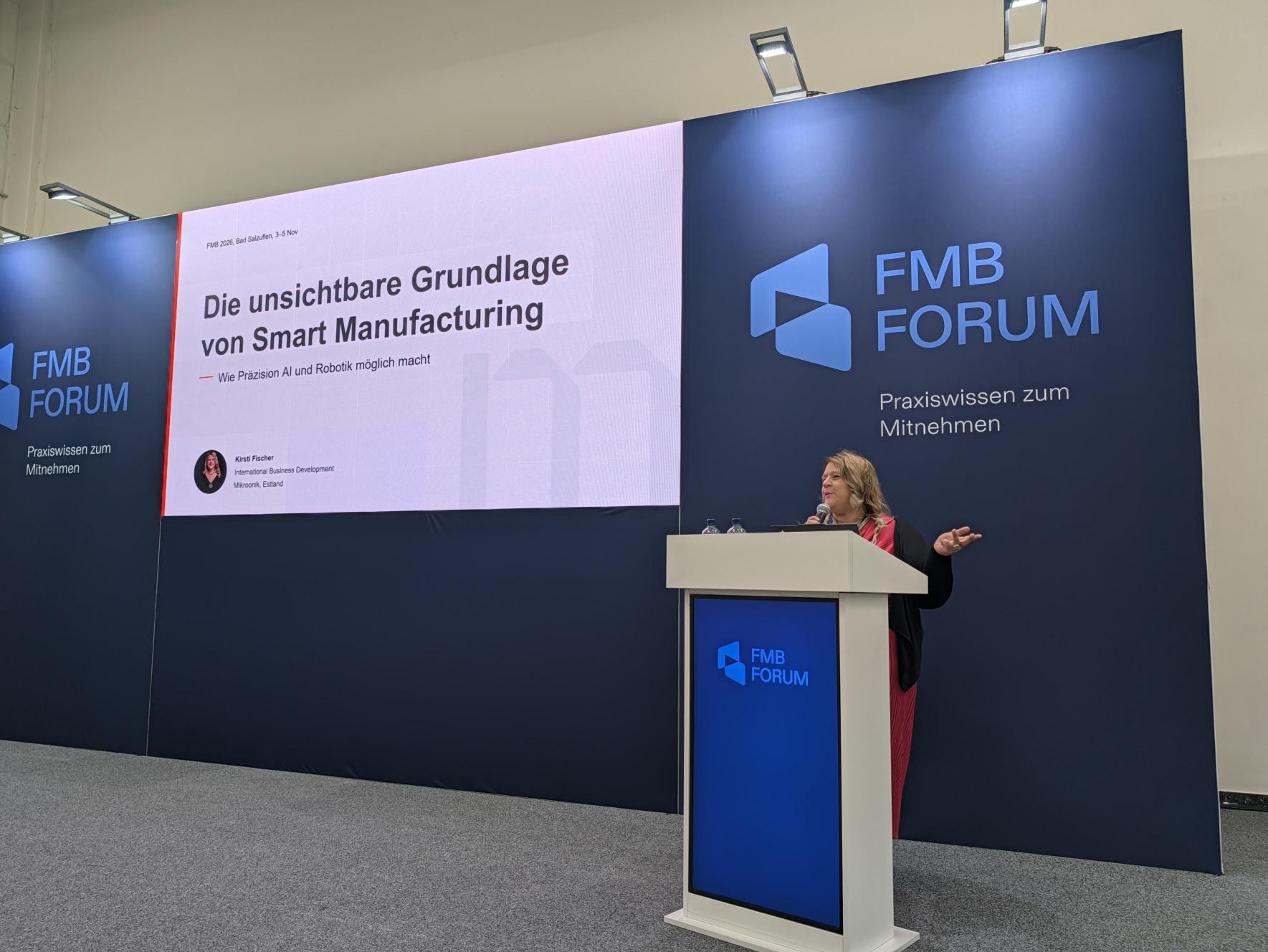
This was the central message Kirsti Fischer, International Business Development Manager at Mikroonik OÜ, brought to the FMB Forum on 3 November 2026 in Bad Salzuflen, Germany.
As one of three Estonian speakers at the forum, alongside Leana Kammertöns from Enterprise Estonia (EIS) and Märt Jõesaar from Mobitek, Fischer contributed an Estonian perspective to the discussion about the future of European manufacturing.
Her presentation highlighted not only the technical foundations of Smart Manufacturing but also the importance of industrial collaboration and greater international visibility for Estonia’s manufacturing sector.
The Invisible Foundation of Smart Manufacturing
In her presentation, “Die unsichtbare Grundlage von Smart Manufacturing – Wie Präzision AI und Robotik möglich macht” (“The Invisible Foundation of Smart Manufacturing – How Precision Makes AI and Robotics Possible”), Fischer addressed a fundamental aspect of industrial innovation that is often overshadowed by discussions about artificial intelligence and digital technologies.
While software, data, and intelligent systems are driving industrial transformation, their performance ultimately depends on the physical components that enable them to function reliably.
“A robot is only as precise as the components it is built from.”
This statement captures a central challenge facing modern manufacturing.
As industrial systems become more advanced, their mechanical components must meet increasingly demanding requirements. Smaller dimensions, tighter tolerances, greater complexity, and higher expectations for consistency are changing the way products are designed and manufactured.
Whether in robotics, automation, sensor technology, or intelligent production equipment, precision manufacturing plays a critical role in ensuring that technological innovation translates into reliable real-world performance.
For Fischer, the future of Smart Manufacturing is therefore not simply about making production processes more digital. It is also about ensuring that the physical foundations of these technologies meet the highest standards of accuracy, quality, and reliability.
Connecting Innovation with Manufacturing Expertise
Drawing on her experience in international business development and her work with Mikroonik OÜ, Fischer emphasised the importance of connecting technological innovation with practical manufacturing expertise.
Modern industrial customers increasingly expect more than components manufactured according to technical drawings. They seek reliable manufacturing partners who understand complex requirements, maintain consistent quality, and contribute to solving challenges throughout the product development process.
This is particularly important in precision manufacturing, where seemingly small details can have a significant impact on the performance, reliability, and manufacturability of a finished product.
At Mikroonik OÜ, precision manufacturing is at the centre of the company’s industrial expertise. The connection between technical requirements, manufacturing capabilities, and customer expectations reflects the broader message of Fischer’s presentation: advanced technologies require equally advanced manufacturing competence.
For companies developing increasingly sophisticated products, collaboration with experienced manufacturing partners can help identify potential challenges earlier, improve manufacturability, reduce risks, and support more efficient product development.
Fischer stressed that successful innovation depends on cooperation across the entire industrial value chain.
Engineers, product developers, manufacturers, suppliers, and technology providers all contribute to turning ambitious ideas into functional, commercially viable products.
The earlier this cooperation begins, the greater the opportunity to align technical ambitions with manufacturing realities.
Estonia’s Manufacturing Expertise Deserves International Attention
Beyond the technical discussion, Fischer used her participation at FMB Forum 2026 to highlight another important topic: the international visibility of Estonia’s industrial sector.
Estonia is widely recognised for its digital capabilities and innovative technology environment. However, its manufacturing and engineering expertise is not always equally visible to international industrial decision-makers.
For Fischer, changing this perception requires active engagement in European industrial networks.
“Estonia has highly capable manufacturing and engineering companies, but many international decision-makers still know surprisingly little about them. For a small country, visibility is essential. If we want our companies to become part of international value chains, we need to actively participate in international industry events, contribute to discussions, and demonstrate our expertise.”
Her message reflects an important opportunity for Estonian manufacturers.
International competitiveness depends not only on technical capabilities but also on the ability to communicate those capabilities, establish trust, and develop long-term relationships with customers and partners.
For smaller industrial markets such as Estonia, participation in international trade fairs, conferences, and professional discussions can play an important role in creating these connections.
By sharing practical industry knowledge and contributing to discussions about the future of manufacturing, Estonian companies can strengthen their visibility and demonstrate the value they bring to European industrial supply chains.
Building Stronger European Industrial Partnerships
Events such as FMB provide valuable opportunities for manufacturers, engineering companies, suppliers, and technology developers to exchange knowledge and explore new forms of cooperation.
For Mikroonik OÜ, participation in international industrial discussions also reflects the importance of understanding changing customer expectations and maintaining close connections with European manufacturing markets.
As industrial technologies become more sophisticated, the relationship between product development and manufacturing is becoming increasingly important.
Companies need partners who can combine technical understanding with reliable production capabilities and a willingness to collaborate.
Fischer’s presentation reinforced the idea that future competitiveness will depend not only on individual technological achievements but also on the strength of the industrial networks supporting them.
Innovation does not happen in isolation. It requires expertise, precision, trust, and cooperation across borders.
This creates opportunities for Estonian manufacturing companies to contribute their capabilities to international projects and become more closely integrated into European value chains.
Looking Ahead: Precision, Partnership, and Visibility
For Kirsti Fischer, speaking at FMB Forum 2026 was about more than presenting a technical perspective on Smart Manufacturing.
It was an opportunity to connect three closely related messages: the essential role of precision manufacturing in advanced technologies, the value of strong industrial partnerships, and the importance of making Estonia’s manufacturing expertise more visible internationally.
As artificial intelligence, robotics, and automation continue to reshape industry, the demand for reliable, high-quality components and capable manufacturing partners will remain fundamental.
For companies such as Mikroonik OÜ, this reinforces the relevance of precision manufacturing in supporting the next generation of industrial innovation.
At the same time, greater participation in international industry discussions can help strengthen Estonia’s position as a valuable partner within European manufacturing networks.
The future of Smart Manufacturing will be shaped not only by intelligent technologies, but also by the precision, expertise, and partnerships that make them possible.